
Quick navigation
Freehold and leasehold houses and flats in the UK must have Energy Performance Certificates (EPC) that rank properties based on their energy efficiency. If you own a home with a low EPC rating, you might find that it’s harder to sell. However, you can take steps to either improve your EPC rating before selling or find a buyer quickly and at a profit without raising the rating.
- What is an Energy Performance Certificate?
- Factors that can affect the EPC rating for your property
- Having a low EPC rating can complicate the sale of your home
- How a poor EPC rating might affect rental properties
- Steps you could take to improve your home’s EPC rating
- Four options for selling your house with a low EPC rating
- Frequently asked questions about selling a home with a low EPC rating
What is an Energy Performance Certificate?
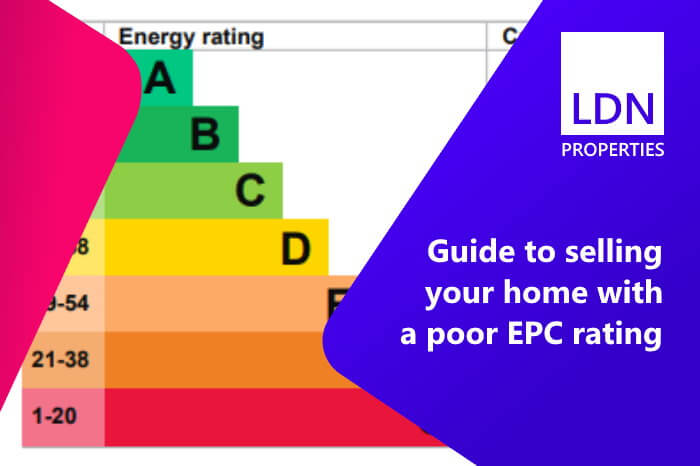
If you own a house or flat in the UK, whether it is freehold and leasehold, you are required to have an Energy Performance Certificate (EPC) when the home is built, rented, or sold. EPCs rank a property based on its energy efficiency, using a scale of A to G where A is the highest possible rating for the most energy efficient homes and G is the lowest rating for the least energy efficient homes.
Just as cars and household appliances like fridges have labels with the energy efficiency rankings, properties that are mandated to have an EPC that will provide a rating based on a review of the home and its services, which includes heating, lighting and ventilation.
The certificate will usually also include details on a property’s typical energy expenses, and provide some recommendations for reducing costs by making it more energy efficient.
EPCs, which last for a decade once issued, became mandatory throughout the UK starting in August 2007. The certificates were originally part of Home Information Packs, or HIPs, which were also called seller’s packs because they included a wide range of details about a property being sold, including any title paperwork that might be relevant, searches performed on the flat or house and more. When first introduced, HIPs were mandatory for any property that had four bedrooms or more, although the obligation was then expanded to three-bedroom homes.
HIPs received a lot of criticism for being very expensive and, in certain cases, creating extra barriers for owners when trying to sell their homes. In response to this pushback, in May 2010 the government decide to halt the requirements for properties being sold to have HIPs. Less than two years later, in January 2012, the government then scrapped HIPs entirely.
Despite abolishing the mandate for owners to have HIPs when selling their properties, the requirement to have a valid EPC remains. You must make sure you comply with this duty, because you could face a steep fine for selling your home without a necessary EPC.
Factors that can affect the EPC rating for your property
EPCs are issued by government-approved experts known as Domestic Energy Assessors (DEAs), who have proven that they are accredited to accurately assess the energy efficiency of properties and issue certificates.
When preparing an EPC, a DEA will look at a home’s floors, roofs, central heating, lighting, windows, walls, hot water and more, and rank them all on their current energy use levels. This will tell you how all of these features are affecting your home’s efficiency and EPC rating.
One issue that can make your home less energy efficient is if it has some structural damage, for example if it is dilapidated and in need of repair, or if there are holes in the walls or roof that let heat escape, which means you’ll have to use more energy to keep your house warm. Anything that requires a greater use of appliances and electricity will therefore contribute to a lower EPC rating.
The certificate will also include details on whether the property has any low-carbon or zero-carbon emitting sources, which are considered efficient and can improve the EPC grade.
And you’ll also see an estimate of the total energy costs, including lighting and heating, for the property, with lower EPC ratings being given to homes that have higher energy costs.
All of these factors will play a role in determining the ultimate EPC grade that a DEA gives to your property when issuing the certificate, which can be used for the next 10 years.
Having a low EPC rating can complicate the sale of your home
If your house or flat has a low EPC rating, it can complicate your attempts to sell the home because some buyers might see this factor as making it a "problem" property.
There are many different issues that people may believe to be problems, ranging from the relatively minor such as noisy neighbours or being situated close to a mobile phone mast through to potentially major factors like widespread subsidence or having a bad roof. Depending on the exact EPC ranking of your property, the grade could be considered either a minor or major problem.
Consider a situation in which a property’s central heating system is very old and inefficient, and requires a large amount of electricity to operate, which will mean increased monthly energy bills for someone that buys the house or flat. The home may be given a low EPC rating as a result, along with tips on how to fix the problem such as paying to install a more modern system. If a buyer has no interest in spending money on that newer system, it’s entirely possible that the presence of the older system and the low EPC grade makes them lose interest in your home.
Alternatively, a buyer in that situation might continue to be interested in your property and willing to invest in the efficiency upgrade as its future owner, but they could still complicate the sale by requiring that you discount the cost of that upcoming work from your home’s sale price. Depending on how much that cost might be, it could significantly reduce the net profit that you might be able to anticipate making from the sale of your leasehold or freehold property.
How a poor EPC rating might affect rental properties
If you’re the freehold or leasehold owner a house or flat that you rent out to someone else to live in, the requirement to have an EPC still remains if you’re looking to sell the property. But there are some planned changes to the certificates that would apply specifically to rental homes, and it’s useful to know about these possible updates when you’re trying to find a buyer.
The proposal, which is not yet final, would mandate that starting in 2025 any property that is newly rented must have an EPC with a minimum rating of C, according to a recent article by the news site Financial Reporter. Currently, the requirement is for these properties to have a certificate whose energy efficiency rating is at least E.
Under the current plan, landlords with properties that have existing tenancy agreements would have until the end of 2027 to come into compliance with the higher EPC rating requirement.
There is some concern from various landlords that, if implemented, the change could result in many properties being effectively classified as not lawful to rent if the owner is unable to take steps to raise the rating to the proposed C grade. If a home is then deemed to be impossible to rent, it might then be seen as impossible to sell because very few, if any, mortgage lenders would be willing to issue a buyer a loan for a rental property than cannot be rented.
And the government’s plan might also affect rental homes if landlords decide to pass the cost of energy efficiency upgrades on to their tenants by increasing the amount of money they must pay to live in the property each month. But if the rental cost is hiked too much, the tenant could move out and it might be almost impossible to find someone else to live in the home, which again could make some mortgage companies consider the house or flat to be a bad investment. If they reject a loan request from a conventional buyer, this could make the sale fall through.
Steps you could take to improve your home’s EPC rating
As described earlier in this guide, when a DEA assesses your property and issues an EPC they will not only provide a summary of the home’s energy efficiency and EPC grade, they might also include a section in the certificate with recommendations for obtaining a higher ranking.
There’s absolutely no mandate for you to implement whatever suggestions the DEA makes for increasing the energy efficiency of the property, and many owners sell their properties with their existing EPCs and not investing any time or money in trying to improve their rating. Indeed, it might not make financial sense for you to invest in such work when trying to sell your home, for example if paying for the improvements would result in you making a net loss from the sale.
Still, some people believe that making energy efficiency upgrades is worth the investment, because there are situations in which it might help to raise the value of your property.
For example, there have been recent press reports about homes in the UK that have seen their valuations drop by thousands of pounds because they have not paid to install more-efficient heating systems. The new systems would require less energy and therefore lower the monthly electricity bills, and could also boost a home’s EPC rating and make some buyers consider the property to be much more valuable.
Another high cost, but potentially worthwhile, investment is paying for installation of solar panels on your property that might help to hike its energy efficiency rating. The renewable power source is environmentally friendly and will generate energy, reducing your home’s reliance on the electric grid. Note that in addition to the expense of solar panels, some buyers consider them to be such eyesores that they will no longer have any interest in owning the property.
Improving the energy efficiency rating of your home does not have to require such extensive work, and it could be done through smaller-scale projects like installing double glazing. You’d still have to assess the costs and benefits of paying for such work before selling, but if an efficiency upgrade is affordable, could boost the overall value of your house or flat, and might make it more attractive to potential buyers, then it could be a worthwhile investment.
Installing good quality insulation for the walls, roof or floors of the property can keep your home warmer and therefore require less use of your heating system, reducing its energy consumption and raising the EPC grade in some cases. But this is a solution that can vary widely in costs depending on the amount and type of insulation needed to achieve energy efficiency gains.
Switching out energy-intensive lightbulbs for more efficient versions is one example of a very low-cost energy efficiency improvement that won’t require any structural work on the home.
Regardless of the steps that you are considering for improving your home’s low EPC rating, make sure that you write an honest budget for any potential work that accounts for all costs of selling the property, including any fees for auctioneers or estate agents, and the time it would take. Only pursue an energy efficiency project before selling your home if it is financially sensible, and the timeline for the work doesn’t exceed your deadline for finding a buyer.
Four options for selling your house with a low EPC rating
Whenever you are prepared to sell your house or flat with a low EPC rating, you will have to opt for one of four possible methods for finding a buyer. The typical choices are trying your luck with a property auction, attempting to sell your home by yourself, enlisting an estate agent to sell your property, or selling to a quick property buyer like the London-based LDN Properties.
All of these approaches have their own unique advantages, although there are certain negative aspects to at least a few of these choices in terms of the time they take or the costs involved.
The best way to choose the right approach for selling your property is to consider the pros and cons of each method, and then compare them to your goals with trying to find a buyer. Can you afford the time and money that certain selling options will require? Be honest with yourself about what you can spend, figuratively and literally, on the sale in order to discover the ideal choice.
Trying your luck with a property auction
With a property auction, you list your home for sale at a certain asking price, and then potential buyers can place bids on it, starting at that value and increasing. Your aim is for many people to be interested in owning your home, so that the bids drive the price very high and produce a great profit. However, there’s no promise that this will happen – you might get zero bids, which would mean your home stays unsold and you have to start again with trying to find a buyer.
Before the auction begins, you’ll be asked to choose a reserve price that is the lowest value at which you agree to sell the property. It’s vital that you select a value which will still produce a profit from selling after you have deducted whatever fees the auctioneer might charge.
The auctioneer will prepare a listing for your home that includes text describing its main features, like the total size and number of bedrooms and bathrooms, and photographs of the interior and exterior. They’ll advertise this listing online and in local media, with the goal of generating interest from prospective buyers to place bids on the house or flat.
Depending on the auction company, you might be asked to choose between selling using the traditional or modern methods. The traditional method involves advertising the listing for a set amount of time and then the auction taking place on a set day for a limited amount of. With the modern method, your listing will be able to accept bids as soon as it’s active, and it will then be open for more bids for a specific duration, with the highest bid at the end of that time being the winner. Whichever of this two approaches you’d like to take, auctioning is still a gamble.
And it can be a time-consuming process, with the first delay being several weeks between whenever you submit your home for listing and the date on which the auction occurs. Even if your property sells, the buyer then has an average of 28 days to finalise it and take care of all of their responsibilities, including paying the proceeds and signing all of their legal documents.
You’ll also have to pay commission, typically charged as a percentage of your property’s final sale, price, which will be deducted from the proceeds and therefore reduce your net profit.
Attempting to sell your home by yourself
Alternatively, some people try to sell their properties on their own, which can be an incredibly stressful, time-consuming and costly experience. You’ll have the sole duty to create a listing, market it, schedule and host viewings for potential buyers to tour your property, field offers, and oversee any final offer through to exchange of contracts and receiving the full proceeds.
This can be a large amount of work and it’s only suggested to pursue selling on your own if you have prior experience with successfully selling a home, and you have the money and time available to spend on doing so – or if you have experienced friends or family members who can help.
The only clear benefit of selling this way is that you wouldn’t have to pay a third party, like an estate agent, any commission. But you can achieve the same no-fee outcome through selling to a legitimate quick buyer like LDN Properties, and without the stress of selling on your own.
Enlisting an estate agent to sell your property
A third choice is to use an estate agent, who will take on the vast majority of the work involved in selling your home – everything from creating and advertising the listing through to organising viewings and overseeing final offers. This can be great if you don’t want to be heavily involved with a lot of effort in the selling process, but it can nevertheless have some drawbacks.
One of the biggest disadvantages of selling this way is the amount of time it can take, and it’s not unusual for some properties to be on the market for more than an entire year before any buyer makes a serious offer. This can be a huge drawback for those homeowners whose top priority is finding a buyer as quickly as possible, for example within just a few weeks.
Some homeowners also find that viewings take up a lot of their free time and can be quite intrusive, whereas if you sell via some other methods, such as using a fast buyer, you typically only have to put up with one viewing as part of the selling process.
Another negative aspect of using an estate agent is that you will have to pay them fees, typically based as a percentage of your home’s final sale price, for their work. This can significantly lower your net profit, causing problems if you need a highly profitable sale.
You might also experience some estate agents giving you an overly optimistic quote for your home’s sale price, which they do to try and win your business so that they’ll earn the commission if they sell the property. Avoid falling for this by asking several estate agents for free quotes, and also looking at the current and past prices of properties like yours on home sales websites, and then calculating the average of all of those values. The resulting price should provide you with a much more accurate estimate of your home’s potential value.
Selling to a quick property buyer
You may consider using a fast home buyer like LDN Properties instead, because we provide a no-hassle and straightforward way to get a competitive and speedy offer for selling your house or flat.
We don’t need to wait months to be approved for a mortgage to buy properties, as we’ve got the financial resources to immediately purchase homes. This means we can usually complete the entire process of buying a home within a handful of weeks after you first contact us, and that includes exchanging contracts and paying you the proceeds. It’s often a much speedier process than compared to the three other options for selling, and also a much less stressful experience.
One reason that we’re able to help so many homeowners with selling is that we are open to making speedy and fair offers for buying almost any property. The type, size, shape, condition or age of the home doesn’t matter, and we have experience with purchasing flats and houses regardless of whether they’re leasehold or freehold, and we can also buy plots of land, vandalised properties and lock-up garages. Other methods for selling may be much more restricted, for example if you’re trying to sell a house with a septic tank via an auctioneer that doesn’t know how to sell such a home.
In addition to homes with low EPC ratings, the wide range of properties that we’ve seen across London since launching in 2003 includes houses with solar panels, homes where the owner cannot find important documents such as the title deeds, listed buildings, properties that have been damaged by floods or storms, inherited retirement homes, flats and houses with damp problems, and more.
Also, you will never have to pay any fees when selling your home to a fast buyer like LDN Properties, unlike the commission that estate agents or auctioneers will charge you. This means that you can count on receiving the full proceeds from whatever price we offer for you house or flat, which is perfect for those homeowners looking for the best profit possible when selling.
Top queries and answers about selling a house with a low EPC rating
Homeowners considering selling their home fast often have some questions for us, particularly when looking to sell a home in bad condition. These are some of the main questions we’re asked about selling a property with a low EPC rating:
Your top questions when selling a property with a poor EPC rating
Yes, you are legally required to have a valid EPC when you are trying to sell your leasehold or freehold house or flat. These certificates last for 10 years after their issuance, and if yours has expired then you must obtain a new EPC. Having a valid EPC is mandatory regardless of whether you’re selling via an estate agent, an auctioneer, or to a speedy property buyer.
Because it’s required by law to have a valid EPC before selling your flat or house, you’ll have to budget for buying a new certificate in case your current one has expired. As a starting price you might pay anywhere from £35 to £45 for obtaining a new EPC, although the exact cost might be higher depending on the type of property and which authorised energy assessor you use.
The UK government’s Department for Levelling Up, Housing and Communities, previously known as the Ministry of Housing, Communities and Local Government, provides details on its website of Domestic Energy Assessors (DEA) that are authorised to assess homes and issue EPCs. Contact specific DEAs to arrange an energy efficiency review of your property.
No. When you receive your EPC, if it has a low rating then the certificate will likely include advice on how you could potentially increase the efficiency of your property and reduce your energy costs. However, there is no legal duty to implement these recommendations before trying to sell, and in many cases it might not make financial sense to do so before selling.
Your best choice is typically to sell to a fast buyer like LDN Properties, because these companies are able to buy almost any type of home regardless of a potential problem like a low EPC rating. The average timeline for selling this way is generally just a few short weeks, and that covers every step through to exchanging contracts and you receiving the sale proceeds.
Yes, legitimate quick property buyers such as LDN Properties will never charge owners any commission for selling their homes, so they’ll get to keep the entire sale proceeds. However, estate agents and auctioneers will always charge fees for successfully selling a property, and these charges will lower your net profit because they’ll be taken out of the sale proceeds.