Quick navigation
Properties are considered to have bad roofs if they are damaged and leak rain inside, which can cause damage to a home. You might find that it’s harder to sell a home with a bad roof compared to other properties, but the good news is that it won’t be impossible. The guide below explains the best options for selling such a home fast.
- When is a property considered to have a bad roof?
- The reasons why buyers might not want a home with a bad roof
- Should you repair or replace your bad roof before selling?
- Why flat roofs are also seen as a problem when selling your house
- The pros and cons of converting your flat roof to pitched
- Deciding on the best method for selling your home with a bad roof
- Top questions and answers about selling a property with a bad roof
When is a property considered to have a bad roof?
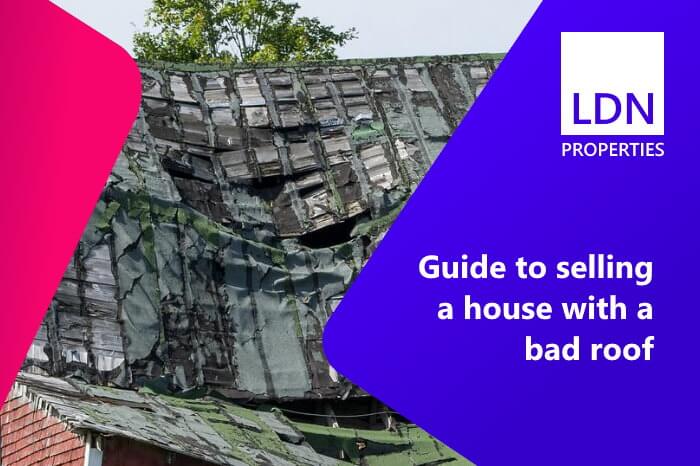
A bad roof is one of the reasons why a freehold or leasehold house or flat might be seen by some buyers as a problem property that will attract less interest than other homes that are for sale.
Wear and tear is natural for any roof, and it’s not usually recommended that people check for widespread damage to their roof more than twice a year – unless there have been some noticeable leaks of rainwater into the property. The occasional missing roof tile won’t usually be enough to make your home be designated as having a bad roof, but if the roof is sagging, has holes and other damage allowing leaks inside your home, or has extensive mould or moss, it’s a bad roof.
Bad roofs are not only a problem that need fixing, but they can cause other problems for your property that can quickly escalate in scope and cost. If water leaks from the roof into the house or flat, it might cause structural damage, create a fire hazard, pose the risk of you slipping and injuring yourself, and a host of other negative issues that may hurt your property’s value.
UK laws and regulations require that sellers disclose as much information as possible about their property to prospective buyers, and that includes telling them about your bad roof.
You should never hide a bad roof from a buyer as part of the mandatory disclosure process when selling your home. The buyer will inevitably find out about the bad roof at some point, and they could then file a court case against you for not disclosing the fact, which is likely to create legal and financial problems that could easily have been avoided by being honest.
Unfortunately, as the guide explains in the next section, the required disclosure that your property has a bad roof can also sometimes be enough to make some prospective buyers lose all interest in buying your home, therefore sometimes possibly making it harder to sell.
The reasons why buyers might not want a home with a bad roof
Unfortunately, if you own a home with a bad roof, you might be struggling to sell it compared to people listing properties for sale that don’t have bad roofs. And there are several reasons why your house or flat might be considered less attractive to buyers, most of them based on financial reasons.
To start with, if you’re selling the home without fixing the roof problem, buyers will have to be made aware of it and they will know that repairing the issue will become their burden. They will have to find the time and money to address whatever problem is causing the bad roof, and if a buyer already has a very limited budget then this could be enough to make them lose interest.
Even if a potential buyer might be interested in your home with a bad roof, and willing to invest in fixing the issue as the new owner, they could still have doubts about purchasing the property based on a fear that the issue might reoccur. Someone could have concerns that they might spend a lot of money and time and fixing the issue, only for it to happen again. This could occur particularly with homes that are located in high risk flood zones or other areas that experience heavy rainfall and other severe weather that could lead to future damage to the roofing.
Another hurdle you might face is that buyers who might want to buy your house or flat even with a bad roof might not be able to get a mortgage to pay for the purchase. Some lenders will be wary about properties that have bad roofs, and they might be concerned that they would not be able to recoup their costs in the event that the buyer falls behind on their mortgage payments, and the lender then has to try selling the home again in order to get their money back. In that situation there is unfortunately nothing you can likely do to try and keep that buyer.
Should you repair or replace your bad roof before selling?
A very important decision that you will have to make when selling your home or barn with a bad roof is whether you should invest in repairing or replacing the bad roof, or selling “as is” which means taking no action to fix the issue and seeking a buyer for the property in its current state.
To find out whether addressing a bad roof is the right move, you need to prepare a budget for the sale of your property. This should include how much time and money you have available for repairing or replacing the roof, how quickly you want to sell your home, and the amount of profit that you would like to make on the sale of your property. Calculate whether fixing a bad roof is within your budget, and do not pursue any such work if it will ultimately mean that you have to sell the house or flat as a loss once you have deducted the costs of addressing the problem.
The average cost of replacing a home’s roof is between £3,700 and £12,000 depending on the size of the property, according to HomeownersCosts, a website that says it aims to make home repair price quotes easier to obtain and understand for property owners. The bigger the problem with a bad roof, the more expensive it will be to fix and it will also take more time to be resolved.
Fixing a bad roof before selling could be useful if it is the sole reason why buyers are losing interest in your property. If you can repair or replace the roof, you remove the problem and also likely provide your home with an increased value because of the work that you’ve had done. But as described above, this is not something that’s required, nor is it feasible for many owners who need to sell their properties fast or that lack the time and money to repair a bad roof.If you don’t fix a bad roof before you look for buyers, you should be prepared for having to sell your home at a reduced asking price. That’s because many buyers will see the bad roof as a structural issue and realise that they will have to pay to fix it once they own your home, and they will naturally want to discount the cost of that work from the total price that they have to pay for the property.
Why flat roofs are also seen as a problem when selling your house
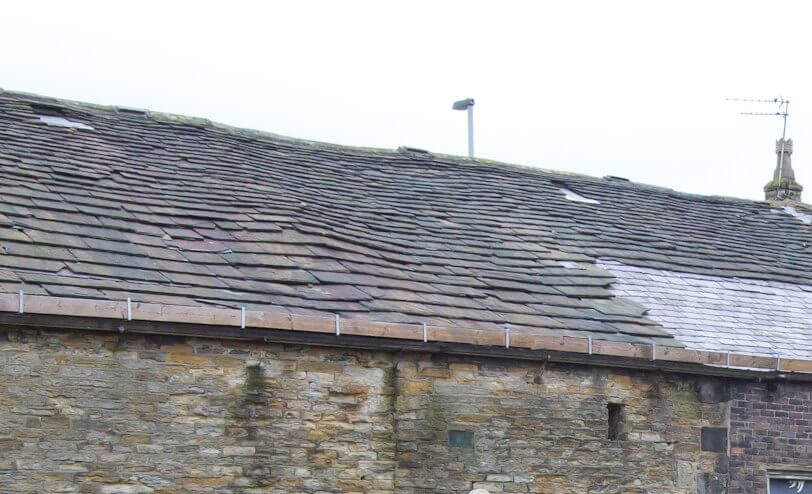
Although bad roofs generally refer to those that have weather damage and are letting rain leak inside a home, they can also sometimes refer to properties that have flat roofs. These are common with blocks of flats that have level roofs rather than pitched roofs on many homes.
Flat roofs are sometimes seen as problematic because rainwater collects on the surface rather than running off the sides into gutters as it would with a pitched roof. This makes it more likely that the roof will eventually suffer some kind of damage, such as sagging under the weight of the water, developing mould or moss, or suffering holes that let water inside the property. These risks alone can be enough for some buyers to no longer have an interest in your home.
The potential for increased damage to the interior of your property means that properties with flat roofs can also be hard or impossible to insure. A recent feature in The Guardian notes that several large UK insurance companies will refuse to offer property insurance if more than 50 percent of a home’s roof is flat. This is because insurers have concerns about the roof’s greater susceptibility to damage from adverse weather that could lead to leaks inside, which then pose a range of problems from mould to damaging personal items.
The pros and cons of converting your flat roof to pitched
If the problem with your property’s roof is that it’s flat, you might want to consider the possibility of paying for work that would convert it into a pitched roof. In simple terms, this would mean your roof would then be at a raised angle, which would make it easier for rain to run off the sides, helping you to avoid the flat roof problem of rainwater gathering in one place.
However, just as repairing a roof that has holes will require time and money, the same is just as true when it comes to installing a pitched roof at a home that currently has a flat roof.
You can expect the work to cost several thousand pounds at minimum, because you’ll not only be paying for the installation of the roof but also all of the related costs such as scaffolding and whatever is required to fulfil the project. It’s only advised that you pursue this kind of work if you can afford the money and time required, and also if you will still be able to sell your property at a profit even after you deduct all of the expenses involved with building a pitched roof.
It might be possible in some very limited situations to construct a pitched roof on your flat roof home without seeking planning permission, but in most instances you will need to obtain planning permission before starting construction. Check with the local planning authority about your project and they will clarify for you whether it has to go through the planning permission process. Failing to adhere to this process can result in you facing some large penalties.
Deciding on the best method for selling your home with a bad roof
If you’re settled on selling your home as is without fixing the bad roof, the next choice that you will have to make is choosing the best method for selling your property. Typically, your selections are selling your home on your own, using an estate agent, using an auctioneer, or selling to a quick buyer.
You’ll find that each of the four approaches has some benefits, although there are also some disadvantages to a few of the choices. The best approach is to draft an honest budget for the sale of your home that accounts for how quickly you want to sell, how much profit you would like to make, and the amount of effort that you are willing to invest in the sale.
Below you’ll find a helpful summary of the pros and cons associated with all four methods of selling that you should help to find the option that best matches your individual situation.
Selling your home on your own
This can be the most stressful way to sell your property, because you will be responsible for every step of the process, and it can also be expensive as you’ll be paying all the costs.
You’ll first have to prepare a listing for your home that describes its main features – such as total square footage and number of bathrooms – and then advertise that listing in local media and elsewhere. Then you will have to field calls from potential buyers, and schedule viewings where you will show the interior and exterior of property. You’ll also have to handle any offers that you get, as well as overseeing any serious offers through to hopeful completion.
Because of the sheer amount of work involved, this option is generally only recommended for those people who have experience with selling properties, or that have friends or family members who have such knowledge and would be willing to help you out for free. Otherwise, you will face many complications compared to any of the other methods of selling.
The sole clear benefit of selling on your own is that you will not have to a third party any commission for finding a buyer for your home, but the costs involved with selling this way can significantly reduce the net profit from the sale. As an alternative, you could find a quick home buyer that will be able to buy your property within weeks and also charge zero fees.
Using an estate agent
It’s possible to significantly reduce your workload when selling by using an estate agent, because they will prepare and advertise the listing, organise and host viewings, and also take the lead on overseeing any serious offers through to exchange of contracts. But selling this way can take a very long time, and your home might stay unsold for months or even a full year, which is far from ideal if your main priority when selling is finding a buyer as fast as possible.
Estate agents will also make you pay commission that often ranges from 1.15 percent to 1.40 percent of your property’s final sale price in exchange for the work that they do in finding a buyer. This fee will be subtracted from the sale proceeds, which in turn will reduce you overall net profit. That’s a setback if you need to make as much profit as possible when selling your house or flat.
You may find that some estate agents will tell you an impressive price for selling your home, but they might not tell you that the reality is you’ll only be able to find a buyer at a lower price. They do this in a bid to get your business and the commission that you will have to pay them. Avoid falling for this trick by browsing Rightmove and other home sales websites and looking at the past and present prices for properties like yours. And ask a number of other estate agents for quotes for selling your home, and then calculate the average of all those values in order to get a more realistic estimate of your property’s potential sale price.
Some estate agents might also not have any experience with selling a property with a bad roof, and if that’s the case, they could find it difficult to know how to generate interest in the home. If that happens, the property is likely to remain unsold until you find another method of selling.
Using an auctioneer
Some homeowners have experienced great success with selling their properties via an auction, where people place bids of ever-increasing value on a house or flat, and the highest bid at the end of the auction is the winner. If many people want to buy your property, it could receive many bids, which will drive the final price high and could make you a decent profit from the sale.
However, there’s no promise that this will happen, and it’s possible your home will not receive any bids. In that situation it would remain unsold, and you’d have to start all over with trying to find a buyer. Or you might get a single bid at the lowest value at which you’re willing to sell, which is known as the reserve price. Just one bid is a binding agreement to buy your home and the winning bidder can sue to enforce this, so it’s important that you choose a reserve price that will still generate a profit for you even after you pay their auctioneer their commission.
And that commission is typically charged based as a perentage of your property’s final sale price, with the fee being taken out of the proceeds before you get the remaining money as net profit. Some property auctioneers might let you transfer the obligation for paying some fees on to the winning bidder, so it’s worth asking specific companies about their policy on this issue.
Just note that in addition to coming with fees, selling via an auction can also take at least several months. There’s a lengthy wait typically between listing your home for sale and the auction ending, and if your property does sell then the buyer usually has about 28 days to sign al of their mandatory legal paperwork and complete all of their other obligations.
Selling to a quick home buyer
Or you could try selling your home to a fast buyer like LDN Properties, who can make a speedy and competitive offer to buy the flat or house with the promise of never charging any fees. It can be a no-stress, straightforward and zero-hassle way to sell your home, and the process usually only takes a handful of weeks – including exchanging contracts and you receiving the proceeds.
A major benefit of fast buyers is that they can consider purchasing almost any type of home, and the age, condition, shape or size does not matter, nor is it important whether the property is freehold or leasehold. That means you won’t face any hurdles trying to sell a home with a flat roof, because quick buyers have plenty of experience with buying so-called problem properties.
For example, some of the many other purchases that LDN Properties, which buys homes throughout London, can consider are plots of land, dilapidated houses, flats with cladding, homes with widespread invasive Japanese knotweed in the garden, properties with subsidence, empty houses, houses built with non-standard construction material such as concrete, and many other situations. We also consider buying properties in all conditions, including vandalised houses.
These companies have the financial resources available to immediately buy properties, so there’s no waiting for a few months to find out if they’ll get approved for a mortgage to complete the purchase. This unique strength means that quick home buyers can typically finalise the process of buying your home within weeks, rather than auctions that might take at least a couple of months, or estate agents who may take more than a year to sell your home.
Also, the trustworthy quick buyers will never make you pay any commission, which means that are guaranteed to receive the full proceeds from whatever price they offer for your property. And it compares favourably to using an estate agent or auctioneer, because both of those methods will require you to pay commission that will be deducted from the final property sale proceeds.
And you have added peace of mind when selling to a quick buyer because the legitimate companies like LDN Properties are registered with The Property Ombudsman (TPO). This is an independent organisation that publishes regulations for its members to follow which are crafted to protect owners against potential fraud in the speedy property buying industry.
It’s fast, free and simple to find out whether a fast buyer is a member of TPO by visiting the organisation’s website, and on the welcome page look to the left for the “Find a Member” tab, click on it and then when prompted enter the name of a specific quick buying company. If they are a true TPO member than you will be able to immediately see their membership details.
You should be incredibly hesitant to sell your home to a quick buyer that claims it belongs to TPO but cannot prove its membership status, or a company that is defiant in refusing to join the organisation, because either situation could potentially be a sign of a scam business.
Top queries and answers about selling a house with a bad roof
If you’re thinking of selling your home quickly you may have some questions for us, ranging from the amount of repair work needed before selling through to selling a home with problems. Here are a few of the main questions we’re asked about selling property with a bad roof:
Top questions when selling property with a bad roof
Typically, a bad roof at a residential property refers to one that has holes or other damage which leads to rain leaking inside the home. This water can cause substantial problems throughout your property, including mould, reducing structural integrity, and destroying furniture. But properties that have flat roofs – even if they are intact – are sometimes said to have bad roofs.
No, there are no laws or regulations that mandate you must repair a bad roof before trying to sell it. Whether or not to replace or repair your roof will depend entirely on your unique situation, including your financial ability to pay for such work, as well as the time and effort you’re willing to invest in it, because it could take a long time to complete depending on the problem.
Yes, unfortunately some buyers will outright not be interested in your home with a bad roof, perhaps because they lack the funds or interest in repairing the roof once they own the property. It’s possible that mortgage lenders might be wary of issuing a loan for buying a house or flat with a flat roof, because some people also look at these as qualifying as being bad roofs.
Yes. If someone expresses an interest in buying your property, you are required by law to disclose as much information about the home as possible, including if your roof is damaged and in need of repair. Hiding this fact from a buyer can create significant financial and legal problems once the sale is completed, because they could sue you for not disclosing it.
If you’ve decided to sell your home as is without fixing its bad roof, your fastest option for selling may be to contact a fast buyer like LDN Properties who can complete the entire process in just a few weeks – and that includes exchanging contracts and paying you the proceeds. Selling through an auctioneer or estate agent could take at least a few months or longer.
Possibly, depending on which choice you make for selling your property. If you decide to use an auctioneer or an estate agent, they will make you pay commission and this will be subtracted from the final sale proceeds. However, if you sell to a quick buyer then they should not charge you any fees, which means you are ensured of receiving the full property sale profit.
An independent entity known as The Property Ombudsman (TPO) writes rules to protect homeowners against fraud in the quick buying sector, and all TPO members must always comply with those policies. Ask specific fast home buyers whether they are TPO members, and if they can prove that they are, this should give you peace of mind when selling your property.