Quick navigation
When you own a Laing Easiform property, you could discover that it’s harder to find a buyer because these and other non-standard construction homes have features that can make them more difficult to sell. This guide outlines ways to overcome potential problems with selling a Laing Easiform home, including advice on the best way to sell quickly.
- What type of homes qualify as Laing Easiform properties?
- External signs that your house or flat may be Laing Easiform
- Potential disadvantages of selling a Laing Easiform property
- Can buyers qualify for a mortgage to buy a Laing Easiform house?
- Choosing the right method for selling your Laing Easiform property
- Frequently asked questions about Laing Easiform homes
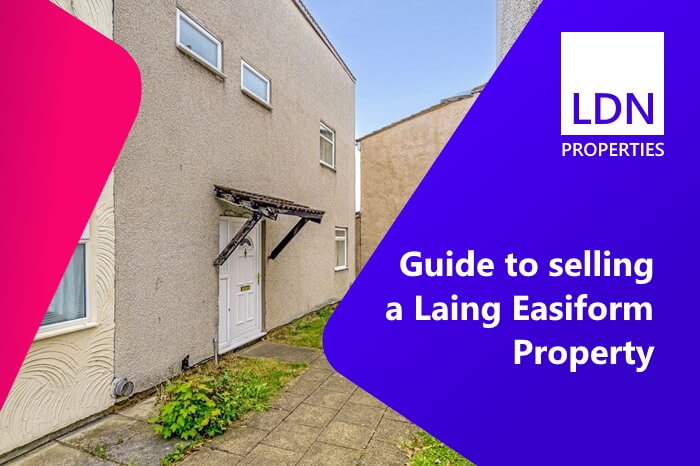
What type of homes qualify as Laing Easiform properties?
There are many different types of properties in the UK that are considered non-traditional, meaning they were built using various methods that differ from the "standard" of a home made from bricks and mortar or stone, and typically featuring a tile or slate roof.
The category of non-standard construction properties is quite large, and applies to almost anything that falls outside of the standard category. This can include prefabricated houses made from concrete after World War II, Wimpey No-Fines property that use a special type of material for construction, mundic homes that were built using a special variety of concrete that is made from mine waste, houses or flats where the walls are made from steel, glass, metal or wood, and properties with roofing that uses thatch, plastic, shingles, and more.
Laing Easiform houses fall into this category of non-standard construction properties. They are not built today, but for a number of years the method of erecting this type of home was incredibly popular across the UK.
That’s because the method of building these properties was relatively cost-effective, speedy and without some of the negative structural problems and other issues associated with other homes built using non-typical construction material. This led to high demand for Laing Easiform properties from after World War I until the 1970s, after which they were no longer built.
These homes are made by building concrete cavity walls instead of the usual brick cavity walls, and steel is used to reinforce the structure. Three different types of Laing Easiform exist, with the first being the MK1 that was used starting in 1919 until 1928. Just a few thousand of these homes were built, with 8 inch walls constructed from concrete that did not include sand or other fine aggregate materials. You will not find many, if any, MK1 homes for sale now.
From 1928 until 1945, the next version of the Laing Easiform home was the MK2, which had a cavity that divided 3 inch thick outer and inner leaves, topped off with gravel or pebbledash. The latter addition was designed to help protect the exterior of the home from bad weather.
And the final version of Laing Easiform properties is the MK3, which is also the most prevalent type still in existence and built from 1945 until the 1970s. The material used for this variety was more adaptable and could be customised more than the MK1 and MK2 types, but the basic idea was the same, using a specific type of concrete that was reinforced with steel for strength.
External signs that your house or flat may be Laing Easiform
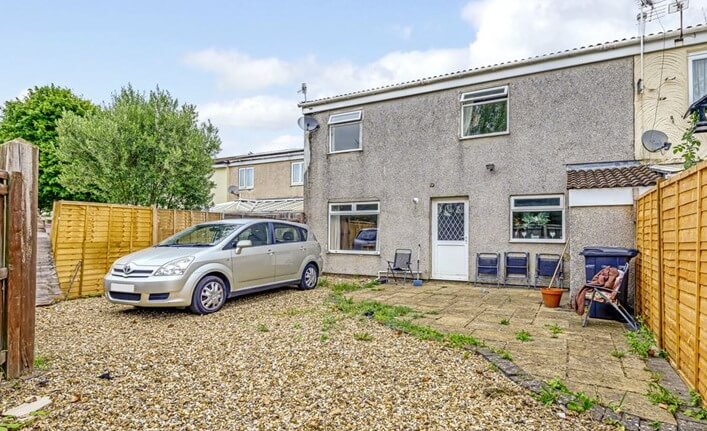
It’s possible that you might not know whether or not your property is a Laing Easiform home, for example if you inherited it and the late owner lost the title deeds and other information. If that’s the case, there is some external evidence you can use to detect a Laing Easiform property.
Knowing whether or not your house or flat is built from non-standard construction material is crucial to establish before you try to sell it, because by law you must disclose as much relevant information about the property, its features, its flaws and more. Buyers will also want to have an answer to the question about whether the home is Laing Easiform.
Even though, as described earlier in this guide, there were three types of Laing Easiform properties constructed throughout their lifetime, they share some common visible features that can help in determining that they are indeed this type of home. The elements include:
Thickness of the walls: Because of the unique measurements of Laing Easiform walls, regardless of whether it’s a MK1, MK2 or MK3 home, this can be a sure sign.
Vents on exterior walls: Another common feature at many Laing Easiform properties is the fact that vents placed on the outside walls of a home are usually in a rectangular shape.
Appearance of the loft: If you look in the loft of a Laing Easiform home, you will see that it has a grey and smooth look, unlike the block and brick lofts of conventional properties.
Concrete front porch: Many Laing Easiform properties featured a porch by the front door, and these were typically made with the use of concrete, another sign of this type of home.
Looking for these features can be a good idea if you have any uncertainty at all about whether or not you’re the owner of a Laing Easiform home. But even if that’s the case and you notice some or all of the above elements at your property, it is worth getting a property expert involved who would be able to help you find out definitively if your home is indeed Laing Easiform.
Potential disadvantages of selling a Laing Easiform property
Non-standard construction properties, such as British Iron and Steel Federation houses, Wimpey No-Fines homes, mundic properties and others, are often are seen negatively by potential buyers because they can have problems with structural integrity, insulation and more that make them less attractive.
You have to be honest and upfront with buyers about any potential negative aspects of your home, because this is required by law. If someone decides to buy your house and then later finds out about a problem with it you didn’t disclose, such as one of the common drawbacks of a Laing Easiform property, then they could sue you and you might face severe penalties.
The three most common problems with Laing Easiform properties are:
Presence of asbestos: These properties were constructed at a time when asbestos use was rife in development, and your home could have asbestos that’s hidden.
Poor insulation: Because Laing Easiform properties were built with typically very thin walls, they can result in poor insulation, requiring more energy in order to keep the home warm.
Potential metal corrosion: Unfortunately, although Laing Easiform properties are considered fairly structurally sound, the metal that is used as part of the process can be at risk of corrosion, cracking the metal – although sometimes not to the extent that it needs any repairs.
You should be prepared for some private buyers to consider that any of these potential negative factors might be enough to make them no longer want to make an offer on your home.
As an alternative to having to face this scenario, you could consider getting in touch with a fast home buying company like LDN Properties. They make speedy and competitive offers to buy almost any type, condition, age, size or shape of home, including Laing Easiform properties and other houses or flats built using non-standard construction materials like concrete.
Can buyers qualify for a mortgage to buy a Laing Easiform house?
People might find it difficult to obtain approval for a mortgage to purchase some properties built from non-typical material, for example Wimpey No-Fines homes. If someone requires a mortgage to cover the cost of buying your home and cannot get approved, the sale will not happen.
Lenders may be wary that the would-be owner may not be able to sell the property in the future, because other buyers might have major concerns about structural flaws, insulation problems, or other issues with the home linked to the non-standard construction material. If the owner were to default on the mortgage, that would give the lender to ability to sell the home in the event they needed to recover the outstanding loan. Some mortgage providers might simply consider a Laing Easiform property too risky and be unable to lend on these.
Laing Easiform homes are, however, seen as one of the more stable non-standard properties. An official UK government-ordered report on the integrity of these houses concluded that "The Easiform house is a robust and substantial form of construction which is unlikely to be significantly affected by minor variations in workmanship or isolated cracking in the concrete, " according to one Member of Parliament’s comments at the time of the report release in 1988, recorded in the official House of Commons transcript.
The same MP said that the conclusions of the report, which also found that neither the structure nor integrity of any Laing Easiform homes were ever in doubt, should be useful for buyers in being able to convince mortgage lenders that the properties are suitable for home loans.
Even though it should be possible for a buyer to obtain a mortgage for a Laing Easiform home, there’s still always the risk that a lender says no, which would make the sale fall apart.
One way to avoid the stress of such a situation entirely is to contact a quick home buyer like LDN Properties, because they do not need mortgages to purchase houses or flats. That’s because they have the financial resources available to immediately buy homes, which reduces the average timeline for selling your property down to just a handful of short weeks.
Choosing the right method for selling your Laing Easiform property
There can be one or many reasons why you want to sell your Laing Easiform house or flat. Perhaps you inherited the property and don’t intend to keep ownership of it, or maybe you need to raise funds to buy your next dream home, or you might need the proceeds to pay for a more overseas.
Whatever the purpose behind the sale, a crucial choice that you will have to make is whether you want to sell through an estate agent, an auction, to a fast buyer, or on your own.
There are specific advantages to all four approaches, such as reducing the amount of work that you will have to do in finding a buyer, or removing as much stress as possible from the overalls selling process. But you should also know that there are some rather significant disadvantages with a few of the methods, such as increased cost due to having to pay a third-party commission for helping to sell your home, or taking longer to find a buyer than some other methods.
To find the right choice, write down a budget for the sale of your home that includes the most important details, such as your ideal sale price, how long you’re willing to wait to find a buyer, whether you want to invest in a renovation before selling, and various other factors. Compare this information against the details of the four methods below in order to find which one provides the best match for your particular wants or needs with the sale of your home.
Selling through an estate agent
One way to try selling your Laing Easiform home is via an estate agent, who will take care of most of the steps involved with trying to find a buyer for your house or flat.
The estate agent will produce a listing for your home, which will features photographs of the interior and exterior, along with a description of the property’s main features – including disclosing that it is a non-standard construction home. They will advertise this listing in their office, online, and in local newspapers, and then organise viewings for potential buyers to tour your property. Finally, the estate agent will field offers, hopefully through to completion.
For this work, however, estate agents make homeowners pay commission. This money is immediately subtracted from the sale proceeds following exchange of contracts and the buyer’s payment, which results in less net profit for the owner.
Selling through this method can also take quite a long time, and you should not be surprised if it takes more than an entire year to find a buyer for your property. Therefore, using an estate agent is far from the best approach if you’re trying to sell your home as fast as possible.
Beware that some estate agents might try a trick of quoting a very generous sale price for your Laing Easiform property, despite privately knowing that the home will only sell for much less. They pull this trick in order to convince you to use their services, so that they’ll get to charge commission if they find a buyer for the property. The good news is that it is fairly easy to avoid falling for this trick, and all it takes is a small amount of effort on your behalf.
Start by asking several other estate agents for free quotes about what they think is a reasonable sale price for your home. Next, visit property sales websites such as Rightmove or Zoopla and write down the present and past prices of Laing Easiform homes in your neighbourhood or nearby. Finally, calculate the average value among all of those prices, and that should be a much more accurate estimate of your home’s possible sale price.
Also note that some estate agents only have the skills to sell a limited range of properties, such as conventional brick houses. They might not know how to attract buyers for Laing Easiform homes, and if that’s the case then your property could take a very long time to sell.
Selling through an auction
Using an auction to sell your Laing Easiform home is a gamble, because you do not know what the final sale price for the property might be, nor if it will even receive any bids.
If your home doesn’t get any bids at an auction, it is deemed unsold, and you’ll have to begin again with the process of trying to find a buyer, which will add months of delay to the process.
But if your home gets even just one bid at the reserve price – the lowest value that you agree to sell your property during an auction – then this is deemed a legally binding transaction, and the winning high bidder could sue to enforce the sale if you then try to walk away from it. Similarly, you could sue to complete the sale if the winning high bidder attempts to abandon it.
You might be offered the choice between the traditional method of auctioning your property or the modern method. The traditional method involves advertising the listing for the home for many weeks or longer, and then taking bids for a limited amount of time on the day of the auction, with the highest price bid at the end of the auction being deemed the winner – and therefore the person buying your property. By contrast, with the modern method, people have the ability to place bids on your home 24 hours a day, seven days every week, for a specified amount of time, and the top bid at the time of the listing’s expiration is deemed the winner.
Auctioneers will charge commission for the work they do. This fee covers the time, money and effort that an auctioneer invests in preparing and advertising a listing for your property, organising any viewings, hosting the auction itself, and overseeing a successful auction through to exchange of contracts.
You might be able to negotiate a lower fee with certain auctioneers, or have them transfer the obligation for paying some fees over to the winning high bidder, so ask if this is possible.
This is not a speedy way to sell a property, and you should expect it to take at least a few months, if not longer. There’s a wait of many weeks or months between when you enter your home for sale and when the auction occurs. And then if your home sells, there will be an average delay of about 28 days for the buyer to complete all of their paperwork and other steps.
It’s possible that some auctioneers might set a longer or shorter deadline for the winning high bidder to finalise the purchase of your home. Alternatively, you could also be able to negotiate a tighter deadline directly with the auctioneer, so contact them to see if this is a possibility.
Just as some estate agents might not have any experience with selling a Laing Easiform home and could struggle to find a buyer for it, the same may also be true for auctioneers. You should ask individual companies whether they have successfully sold Laing Easiform homes at previous auctions, as well as the price at which the properties sold. Any auctioneer that has never managed to sell this type of home in the past could find it difficult to sell your property.
Selling to a fast property buyer
Using a quick home buyer can be the best way to sell your Laing Easiform home fast whilst still making a decent profit. These companies, such as the London-based LDN Properties, have the financial power to buy homes right away – they don’t have to wait for many weeks or months to win approval for a mortgage, and this significantly speeds up the selling process.
You’ll usually only have to wait a handful of weeks for completing a sale when using a quick buyer, which on average makes it the swiftest way to sell a property by far.
Another top benefit of using a quick buyer is that the legitimate companies will never make you pay any commission, so you can count on receiving the full proceeds from the final sale price that you’re offered. This compares very favourably to estate agents and auctioneers, because they will make you pay fees that are taken out of the proceeds, lowering your net profit.
Quick home buyers also don’t discriminate against properties because of any structural problems, potentially undesirable locations, or anything else to do with their age, condition, shape, size or type. In addition to Laing Easiform properties, LDN Properties for example has experience with offering on vandalised houses, plots of land, flats with low Energy Performance Certificate grades, homes located in high risk flooding zones, properties located next to railway lines, houses of multiple occupancy, commercial properties, listed buildings, flats that have current tenants who have many years left on their rental agreements, and more situations.
That means you’ll get a fair offer for your Laing Easiform home, even if you might struggle to get a competitive price when trying to sell through other methods, hopefully reducing your stress.
Selling your home on your own
This is the least common method for selling your property, because it requires you to do all of the work in preparing and advertising a listing for the home, organising and leading viewings for potential buyers, and overseeing any serious offers hopefully through to completion.
It’s a huge undertaking and only recommended if you have extensive experience with selling a property, or have a qualified friend or family member who might be willing to help you for free. This is not something that you will be able to do in your spare time, and it can also be incredibly stressful because it will require that you spend a lot of time, money and effort on the work.
The only obvious benefit of selling on your own is that you will not have to pay any fees to an estate agent or auctioneer for finding a buyer. However, this exact same result can be achieved with zero stress by selling your property to a quick buyer that won’t charge any fees.
Another negative aspect of selling a Laing Easiform on your own is that it can take a very long time, and you should expect to wait at least a full year before being able to sell.
Top queries and answers about selling a Laing Easiform house
Homeowners wanting to sell their home fast often have a series of questions for us, such as how much repair work to do before selling through to selling a home in bad condition. Here are some of the top questions we’re asked when it comes to selling a Laing Easiform property:
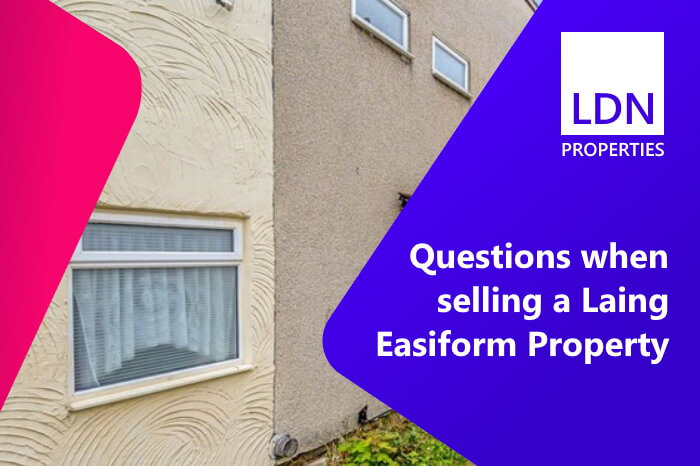
Your top questions when selling a Laing Easiform property
There are certainly a number of common visible characteristics that many Laing Easiform homes share, and that can be good evidence that you own such a property. These include the presence of rectangular vents on the home’s exterior wall, measuring the thickness of the property’s cavity walls to see if they meet Laing Easiform specifications, and other features.
Yes. Some non-standard construction properties are considered to have structural concerns that might make mortgage lenders refuse to provide a loan for purchasing the house or flat, but this does not apply to Laing Easiform homes, which are seen as more durable. However, you can avoid any mortgage issues by instead selling your property to a quick cash buyer.
Unfortunately, there can be a few negative aspects of being the owner of a Laing Easiform property, including the possibility of large amounts of asbestos used in the construction of the home, potential corrosion and cracking in the metal supports that are used during the building of the property, and poor insulation that can lead to more expensive monthly heating bills.
Contact a quick home buyer such as LDN Properties, because they can exchange contracts and pay the sale proceeds to homeowners within just a few short weeks. That’s a much more rapid schedule than you can expect when selling at an auction, which usually takes at least a few months, or through an estate agent, which might possibly take an entire year.
Auctioneers charge homeowners commission for the work they do in selling your property. Estate agents also charge fees often based as a percentage of the home’s final sale price. But you can avoid having to pay commission altogether by selling to a fast buyer like LDN Properties that charges zero fees.
Ask individual quick property buyers whether they are members of The Property Ombudsman (TPO), a third-party entity that publishes regulations which are designed to protect owners from falling victim to fraud in the quick buying industry. Avoid selling your home to any fast buyer that cannot prove it is registered with TPO, because this might be an illegitimate business.